

Legacy history, not a current deck recommendation. This article looks back at the format before April 24, 2017.
For years, blue-white Miracles gave Legacy control players a remarkable choice: answer what mattered now, or arrange the top of the library so the next spell would be answered automatically. The deck’s signature engine paired Counterbalance with Sensei’s Divining Top. On April 24, 2017, Wizards of the Coast banned Top in Legacy. Understanding that decision explains both why Miracles mattered and why tournament logistics can matter alongside win rate.
What the old Miracles engine did
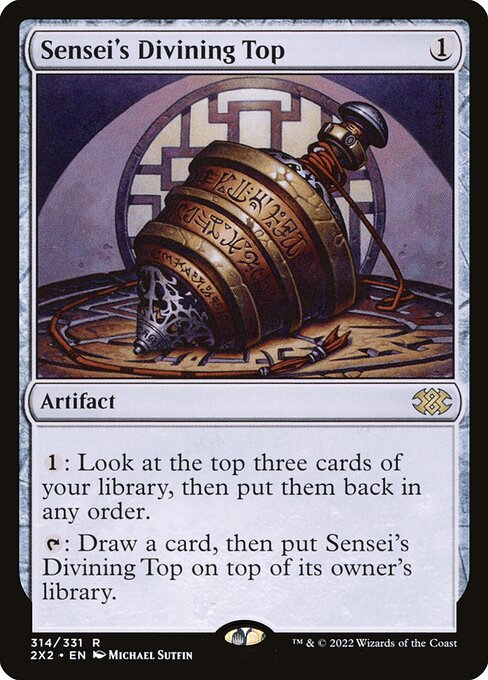
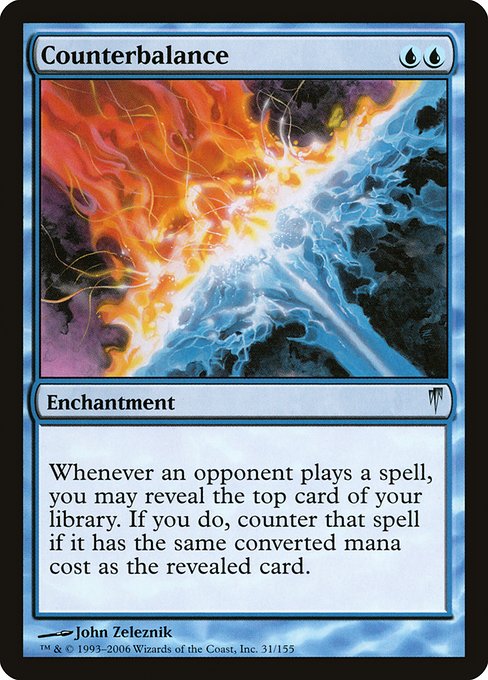
Counterbalance can counter an opponent’s spell when the top card of its controller’s library has the same mana value. Top let its controller inspect and rearrange the next three cards, so Counterbalance was much less dependent on chance. The same library control also made the deck’s miracle spells easier to set up. A Wizards format guide from 2015 presented Yuta Takahashi’s white-blue Miracles as a snapshot of that era, with Top, Counterbalance, Brainstorm, Ponder, Terminus, and Entreat the Angels.
That list is historical evidence, not a current legal deck list. Its appeal was the way its pieces overlapped. Cantrips found interaction; Top improved draws and supported Counterbalance; miracle spells supplied efficient defensive and finishing turns. The pilot still had to make exact decisions about what to leave on top and when to spend mana. The opponent had to decide whether to challenge the lock, force action at a different mana value, or pressure the board while the Miracles player set up.
Why Wizards acted in 2017
In the April 24, 2017 banned and restricted announcement, Wizards described Miracles as the format’s best deck for some time. The announcement did not treat strength as its only reason for action. It also cited repeated Top activations, slower match play, and tournament delays. Top was banned in Legacy effective that day, including on Magic Online.
That distinction matters. The official explanation combined a metagame judgment with an operational one: a powerful deck that repeatedly consumed match time posed a problem beyond the games it won. Calling the ban merely a reaction to an unbeatable deck misses half the stated reasoning.
What the ban changed—and what it did not prove
Removing Top broke the precise Counterbalance-and-Top engine that had defined this version of Miracles. It did not mean that every blue-white control idea disappeared, or that a 2015 list can be transplanted into today’s Legacy. Card pools, bans, and opponents change. For a current tournament, check the official Legacy banned list before building; as checked on September 29, 2026, Sensei’s Divining Top is still listed there.
The useful lesson for a control player is about engine design. A card can be valuable because it connects several jobs: smoothing draws, making a soft lock more reliable, and setting up a payoff. The useful lesson for a tournament player is just as practical: repeated small actions have a real time cost. When evaluating a powerful strategy, ask not only how often it wins, but how it plays across a full round.
Where to go next
For a contemporary deck guide rather than a historical case study, see our September 2026 Orzhov Lifegain Standard guide. The formats and legal card pools are different; the shared question is how the engine’s pieces support a clear game plan.